Craft as Distraction, Craft as Progress
Craft as Distraction, Craft as Progress
Let me tell you a confession:
I’m an inveterate procrastinator. I’m apt to not finish things, especially my own writing project. It can be a problem.
Mainly, I get hung up on the cohesiveness of my essay or book-length memoir. Here are the voices that stop me in my tracks:
“What am I trying to say?”
“How on earth will I structure this?”
“Does this work at all?”
“Who cares?”
All of these haunting, spectral moans and groans — Eeethan … Don’t continue …. Why bother? …. can prevent me from making progress and scare me away from my desk.
What I often forget is that the solutions to the big picture problems will recede into the dust if I focus fully on the craft. If I’m stuck on the big picture, I can still make progress on the little stuff.
By “little stuff” I don’t mean “not important stuff.” I mean, endeavoring to write a good scene, or to amp up my use of reflection, or to experiment with structure, or to find a new voice to tell my story. Whether it’s a novel, short story, personal essay or TBD length CNF project, sometimes, I can assuage and even defeat those destructive voices by actually focusing on these smaller elements of craft.
If I’m unable to construct the hulking architecture of my book, I can still focus on crafting an effective, dramatic, turning point moment in my narrative, in a slowed-down, up-close way—one that showcases one of my protagonist’s most charged emotional moments. A scene.
If I can’t figure out the character arc of my entire novel, I can still get better at revealing the interiority of one character, at one single low-point on their emotional trajectory. What their internal emotional landscape and “making sense” voice sounds like.
If I’m bored with the sounds and patterns of my words on the page— which might feel plodding, or dull, or whiny, or holding something back—I can fiddle with the knobs on my own voice box and try another channel.
If I'm daunted by the idea of chapter to chapter progression of my story and how it maintains narrative tension, I can still play with inventive forms — a braid, a parallel structure, a borrowed form, crossing cutting between storylines — on a smaller scale.
Zeroing in on the little things can distract us from solving the big things and may end up actually solving bigger challenges in our manuscripts.
And, as a reminder, I call it “craft” (and not only “art”) because I believe these are skills that can be taught, practiced, and mastered.
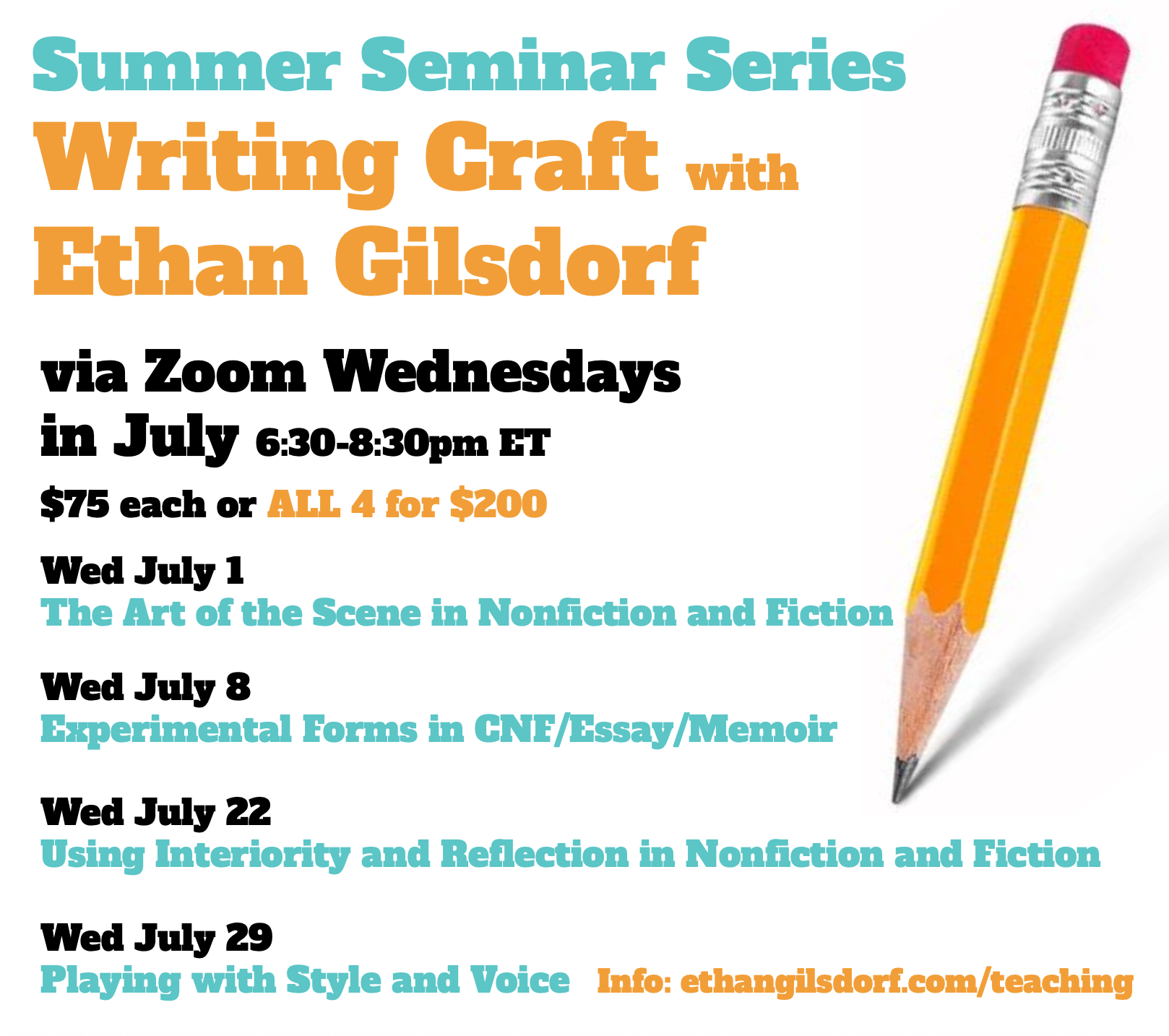
I’m offering a four-part online session, called Summer Seminar Series: Writing Craft with Ethan Gilsdorf.
Over 2 hours, we will explore the fundamentals of an essential craft element. These seminars include discussion of examples and time for in-class writing exercises to try out what you’ve learned. For all levels of writers. Online via Zoom. $75 each or → BEST DEAL: Summer Seminar Series Four Pack: Sign up for all 4 for $200. Register.
The Art of the Scene in Nonfiction and Fiction
Wed July 1, 6:30-8:30pm ET, $75
Whether you're writing memoir, fiction, essays, or narrative nonfiction—great scenes are the backbone of unforgettable storytelling. In this live seminar, you'll learn how to:
-Build tension that keeps readers hooked
-Create scenes with clear stakes, conflict, and character arcs
-Use screenwriting techniques to bring cinematic power to the page
-Add depth and interiority while grounding your writing in truth
We'll break down examples from writers like Cheryl Strayed, Stephen King, Michelle Kuo, and more to learn exactly how master storytellers do it—and how you can too. Register.Experimental Forms in CNF/Essay/Memoir
Wed July 8, 6:30-8:30pm ET, $75
We’ll examine the myriad forms of the experimental personal narrative—such as lyric forms, research braids, flash, micro-essays, and hermit crab forms—to discover unexpected ways to tell epersonal stories. We'll examine work by Ira Sukrungruang, Neema Avashia, Brian Doyle, Gwendolyn Wallace, Roxane Gay, Brenda Miller, and Sabrina Imbler for inspiration. Register.Using Interiority and Reflection in Nonfiction and Fiction
Wed July 22, 6:30-8:30pm ET, $75
Your audience wants to know what is going on in the minds of your characters. This state-of-mind, state of heart consciousness —both “interiority” and “reflective voice” —can happen in the middle of a scene, or a narrator looking back on events. Smart use of interiority and reflection, from the benefit of distance and passed time, gives your narrative that “so what?” We will look at examples of interiority and retrospection from writers such as Michelle Kuo, Zadie Smith, Calvin Hennick and Cheryl Strayed. Register.Playing with Style and Voice
Wed July 29, 6:30-8:30pm ET, $75
Do you feel as though your writing lacks a certain distinctive flavor? Do you struggle to find your “voice”? In this seminar, we’ll explore how to create a distinctive and engaging writing personality on the page, a unique persona for the writer, and a clear perspective on your story—sober, comic, sarcastic, in relation to the your story, by examing word choice, diction, syntax, sentence variety, figurative language and tone. Register.